Fara
About Fara
Research & Clinical Programs
Patient & Family Resources
Ways to help
Research and clinical programs

Research Pipeline

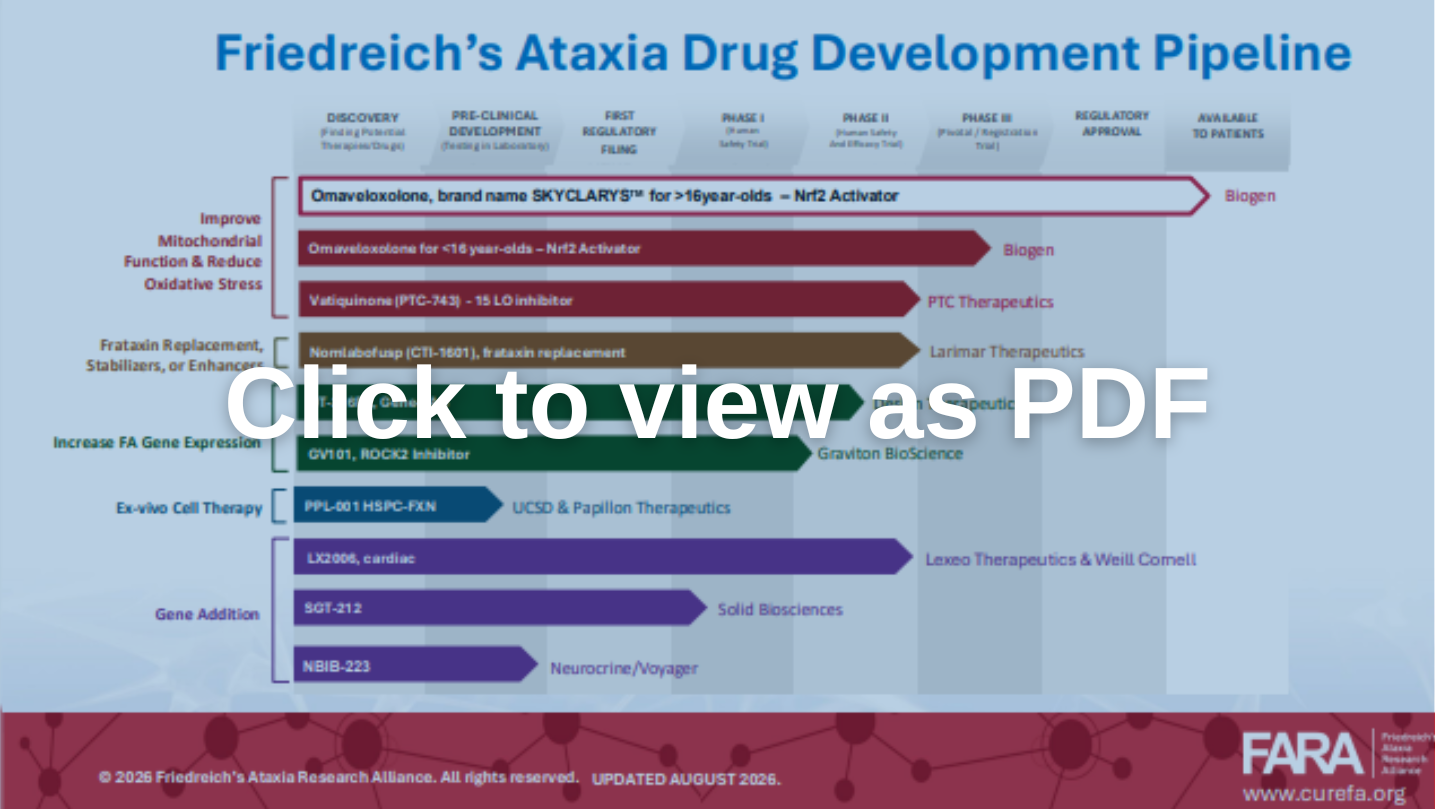
The Friedreich’s Ataxia Pipeline is an illustration of the various therapies being developed by FA scientists.  On the horizontal axis, each leading drug candidate is represented by its own bar and is grouped by its mechanism of action.  Each mechanism of action targets one of the known causes of Friedreich’s ataxia.

The milestones for drug development are listed on the vertical axis. For further information on the drug development process and what these milestones mean; please visit the Clinical Trials page, in the Patient & Family Resources section. 


Treatment Pipeline


FARA is supporting the advancement of these treatments with financial resources, advocacy, and/ or fostered collaboration.  FARA believes that there is merit in each of these approaches and that effective treatment will come in the form of a “cocktail approach”- a combination of two or more therapies.

Drug- Idebenone
Sponsor: Santhera Pharmaceuticals
A Phase III Study of Idebenone is now underway at the Children’s Hospital of Philadelphia (CHOP) and the University of California Los Angeles (UCLA).  It is based on results of the promising phase II study conducted at the National Institutes of Health (NIH) and published by DiProspero et al in Lancet Neurology. The phase II study showed that high doses of Idebenone were well tolerated and demonstrated a “trend to neurological benefit.”

FARA is working closely with Santhera to help with patient recruitment through our patient registry. Each patient is to be in this trial for only six months. The sooner the full number of patients is enrolled, the sooner the trial will be completed so the FDA can make a decision regarding approval. We need just a few more patients in order to be fully enrolled.  Patients from 8 to 17 years of age and able to walk 25 feet without assistance from another person can be enrolled by calling or e-mailing the nearer of the two centers:
CHOP: 267-426-7538 friedmanl@email.chop.edu
UCLA: 310-794-1225 SPerlman@mednet.ucla.edu

Drug- A0001
Sponsor: Edison Pharmaceuticals/Penwest Pharmaceuticals
A0001 is the compound discovered by Edison Pharmaceuticals that shows such promise of improving mitochondrial function (energy production) in FA patients and other patients with mitochondrial dysfunction disorders. Edison has now partnered with Penwest Pharmaceuticals for the purposes of advancing A0001 through clinical trials. The Edison-Penwest team initiated phase I of the A0001 trial in July 2008.  The dose escalation for this phase will be done healthy volunteers--  in whom the dose escalation can be done much quicker than in FA patients. The plan is then to conduct the phase II in FA patients using the optimum dose.

Drug- Pioglitazone
Hôpital Robert Debré, France
Dr. Pierre Rustin has proposed investigation of Pioglitazone, a prescription drug commonly used in the treatment of type II diabetes, as a potential treatment for FA. In addition to working through insulin pathways, pioglitazone, a well known PPAR y (peroxysome proliferators-activated receptor y) ligand induces the expression of many enzymes involved in the mitochondrial metabolism, including the superoxide dismutases. This agent may be therapeutic by counteracting the disabled recruitment of antioxidant enzymes in FA patients. Pioglitazone has been shown to possibly act on neurodegeneration in human and animal models thus it appears a promising agent to be tested in Friedreich ataxia.

Dr. Rustin has initiated a proof of concept trial in France to explore the effects of Pioglitazone on neurological function in FA patients. They are looking for patients less than 22 years of age. Patients will be treated two years and will undergo clinical exams and testing during two days each six months at the clinical investigation center. Of note, individuals with Type I diabetes and those at risk for congestive heart failure should not take pioglitazone.

Drug- Deferiprone
Sponsor: Apopharma
A phase I/II study of Deferiprone (iron chelator) will be initiated at a number of international sites such as France, Belgium, the UK, Italy and Spain in Spring or Summer 2008.  ApoPharma is working with FA clinicians in Canada and Australia regarding additional sites.  This trial is based on very promising results in a pilot study conducted in France and published last year by Boddaert et al in Blood. If this phase I/II study demonstrates safety and benefit, ApoPharma will submit the trial data to the FDA in hopes of including the United States in a phase III trial of Deferiprone. FARA is working closely with the company to help with patient recruitment through our patient registry.

Drug- Erythropoietin (EPO)
EPO is a hormone produced in our bodies and is also an approved drug used to increase red blood cells. It is commonly used in dialysis and cancer patients as well as in patients just prior to surgery in which loss of blood is anticipated. Austrian researchers Drs. Scheiber-Mojdehkar and Sturm found that EPO increases frataxin levels and last year completed very promising proof-of-principle studies in FA patients (submitted for publication). Edison Pharmaceuticals is working with the Austrian investigators, our FA clinical research network and the FARA-MDA partnership to initiate an EPO trial late 2008/ early 2009. 

Drug- HDAC (Histone Deacetylase) inhibitors
Sponsor: Repligen
HDACs are the compounds discovered for FA by Dr. Joel Gottesfeld of The Scripps Research Institute in La Jolla, California. These HDAC inhibitors act at the DNA/gene level and increase frataxin in cells from FA patients and in FA animal models.  The Repligen Corporation has licensed these HDAC inhibitors from Scripps for the purposes of advancing them through preclinical development and clinical trials in FA. Repligen and Dr. Gottesfeld are working very closely together, with support from FARA, MDA and GoFAR, and with the FA mouse-model investigators so as to develop the very best HDAC inhibitor for FA, take it to the FDA later this year and into clinical trials as soon as possible thereafter.

Additional Approaches- TAT-frataxin, Iron-sulfur clusters, High Throughput Screening
Throughout the research pipeline are other early stage research studies that are focused on discovery of new treatments. We believe that we need multiple shots on goal in various areas to ensure successful treatments are delivered to all patients with FA. For example, on the far right of the pipeline are drug discovery studies using a technology called high throughput screening. Each of these studies is different in that the researcher has developed an assay to measure a desired outcome (e.g. improved mitochondrial function, increased frataxin, etc.) and the assay is then used to screen large libraries of compounds to identify “hit compounds” or new drug targets.